What it does · delivery orders
The delivery order, priced and signed at the case.
A spine case can put twenty line items and five figures on one delivery order. FieldRep Ops writes that order up in the room, prices it from the manufacturer's sheet for that hospital, takes the nurse's signature and the rep's, and stamps it with a number that never changes. Every number downstream, the purchase order, the commission, the month, comes from this one signed record.
What goes on the order
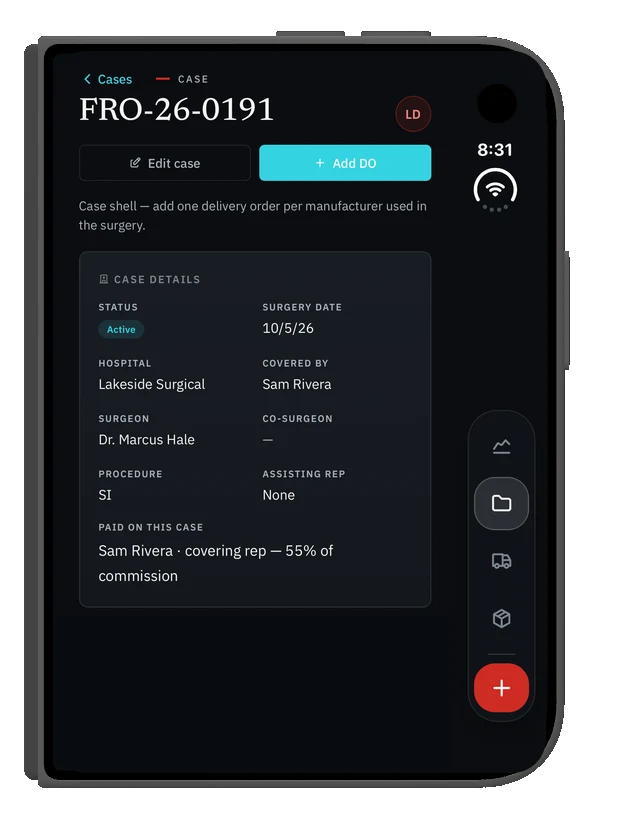
The case carries the hospital, the surgeon, the procedure, the surgery date, the covering rep and an assisting rep if there was one. Each manufacturer on the case gets its own delivery order. Each line carries its section (implant, disposable or explanted), item number, description, lot, serial, quantity, unit price and extended price. Photos of the device labels can be added to the order, up to six.
The case the delivery orders hang off, on the folding iPhone, closed. Sample data.
Priced from the contract, not from memory
Every manufacturer prices differently by hospital and purchasing group. The order loads the manufacturer's price file for that hospital's contract, so the rep picks the parts and the prices fill in. The prices are copied onto the order when it is written, so a later price-sheet import never changes an order that has already been signed. A manufacturer that prices after the case can be set up that way too, with leadership entering the prices afterwards.
Signed in the room
The nurse signs on the phone, with name and title, and the rep signs. Each signature carries its time. Once signed and locked, the order can go to the hospital; an unsigned one cannot. While the order is being built it saves itself as items are added, so a rep who is interrupted mid-case does not start over.
A number that is never rewritten
Every order carries a document number in the form PREFIX-26-0035-01: your prefix, the year, the case, the order within the case. It is stamped when the order is created and never rewritten or reused. A voided order leaves a gap. The number on the paperwork that left the building is the number in the system, for good.
Corrections are recorded, not made quietly
After signing, a delivery order is not edited in place. Each correction records the old value, the new value, who made it and why, and prints on the order in a Corrections block with a tag on the changed line. A rep can fix a lot number or a nurse's name within a day of signing. Anything that touches money or quantity goes through leadership. Leadership marks each correction reviewed.
The patient identifier stays out of the money
The only patient-linking data on a case is the hospital's patient identifier and the case date, in one field, encrypted with a separately held key and deleted on a schedule once the case is paid. There is no field for a patient's name. The order that goes to procurement carries the case number, not the identifier. The security page covers the rest.
What it does not do
No patient names, anywhere: there is no field for one. Not an electronic health record, and not connected to one.
Straight answers
How is a spine delivery order priced in FieldRep Ops?
From the manufacturer's price file for that hospital's purchasing contract. The rep picks the parts used and the prices fill in. Prices are copied onto the order when it is written, so a later price-sheet change never alters a signed order.
Who signs the delivery order?
The nurse, with name and title, and the rep, both on the phone in the room. Each signature carries its time. The order locks once signed, and only a locked, signed order can go to hospital procurement.
Can a signed delivery order be changed?
Not in place. Each correction records the old value, the new value, who made it and why, and prints on the order. A rep can fix non-money fields within a day of signing; anything touching money or quantity goes through leadership.
Does the delivery order carry patient information?
Only the hospital's patient identifier and the case date, held in one encrypted field on the case and deleted on a schedule once the case is paid. The order sent to procurement carries the case number, not the identifier. There is no field for a patient's name.
Does it work with no signal at the hospital?
A weak signal costs you a moment, never your work. Every edit to a delivery order is saved as you make it, the app opens from the phone on slow hospital wifi, and a banner says when the phone is offline and when it is back. For an operating room with no service at all, print a blank paper delivery order ahead of the case: the nurse signs the paper, and you enter the order afterwards as usual. More on weak or no signal.
Is there an app for the phone?
Yes. FieldRep Ops installs to the phone's home screen from the browser and opens from its own icon, full screen, with nothing held back. An iPhone app in the App Store is planned for the first quarter of 2027, and an Android app later in 2027. More on what beta means.
What it does, page by page
Each page describes one thing the system does for a spine distributorship, checked against the product as it runs today.
One signed record, for the whole spine distributorship
All of it keys off the delivery order signed at the case. From that one record come the send to procurement, the follow-ups, each rep's statement, the match against the manufacturer's statement, the tray check-in and the closed month. Nothing is retyped, so nothing drifts, and every total is reconciled back to the signed orders before every release and every week in production. It runs in a private environment that is your spine distributorship's alone; the security page says exactly what that means, in a form you can check.
Founding distributors
We are taking on a small number of founding spine distributors now, who use FieldRep Ops free while it proves itself on their books and know the price before they start. One private environment per distributorship; nothing shared with anyone.